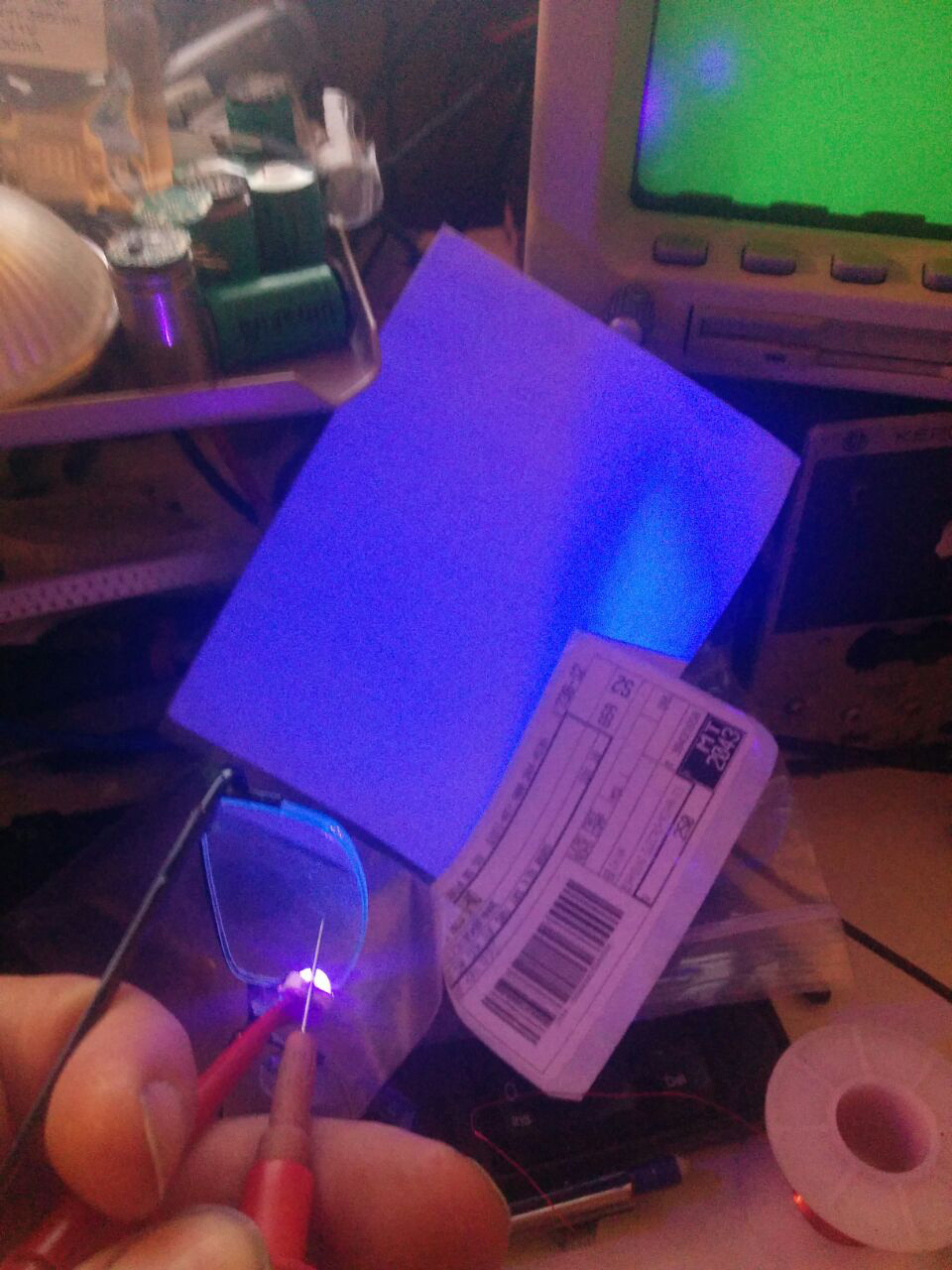
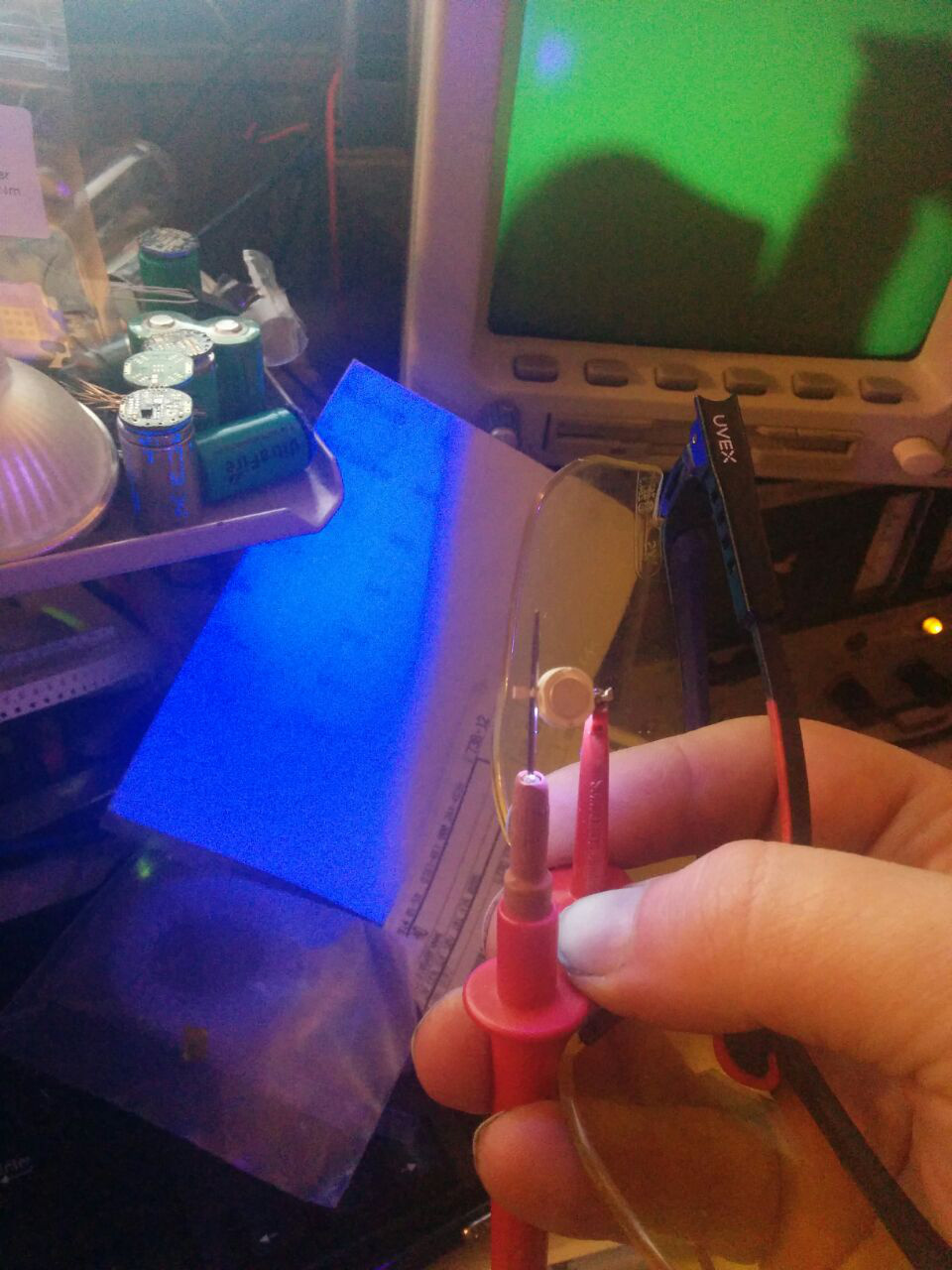
I got some 360-365Nm UV LEDs from china because I wanted to make a high intensity UV flashlight and learned some very valuable things from some tests tonight.
First - DO NOT FUCK WITH THESE THINGS!!! sorry about the language but the emphasis is needed. I’ve worked as a welder and know what arc-flash is… these things produce the mild headache and eye aching in half a minute or even a few seconds of direct exposure that tig welding at similar distances would cause.
I don’t normally go for safety - I usually think it’s overrated or over exaggerated… this one isn’t. If you’re going to play with these LEDs, wear safety goggles. Treat these as welders for protection. If you can’t get safety goggles, wrap-around style safety glasses, especially yellow or tinted, may work for shorter periods. Normal glasses will not (though they do work better than nothing).
Please note that the LED I tested with there is 5W max and I was running it at about 1.5W. My eyes pick it out as a dim white - the camera shows it as bright white (but does not show the ambient lighting caused by a similar white light) but both see the blue and green of the paper and oscilloscope screen.
If you do play, know what you’re doing.
I’m completely cancelling making these into a flashlight… way too dangerous to be in a form-factor which people will not respect. I may make one into a form of directional emitter, but that’s going to need some strong labels. Otherwise I think these will end up in projects to make floating objects glow within spaces I can control where the light is going.
wanted people to know and think 'bout this… thanks
I have been avoiding anything near infrared and ultra violate for that reason. I am been recently working with 50W leds. Not something you want to look at. But a co-work looked right at and counted the COB rows of leds and confirmed they all are working. Young guy with good eyes, guess he figured would recover quickly.
I’m looking at various ways to operate a device normally consuming about
50mA from a 3.7V LIPo battery in a totally waterproof case using either UV
or Inductive coupling so that NO exposed electrical contacts exist.
I wonder how much energy can be transferred/collected using a photovoltaic
array (solar cell) using one of these with a distance between tx and rx of
approv 10mm?
I would love to experiment with one of these. (Using appropriate eye
protection)
F
With UV light, probably close to zero. PV is most sensitive in the infrared, and falls off the bluer you get. You’d be best off using near IR LEDs (<1000nm).
Doing some handwaving, if we say power LEDs are ~20% efficient and a simple PV setup is ~10% efficient at the (IR) LED wavelength, your power transfer efficiency will be about 2%. So with 50W in, that’s 1W. You need about 200mW, so maybe you can get away with 10W in if you have good optical coupling. Maybe.
Inductive is going to be much more efficient, and there already exist inductive power transfer solutions for cell phones that you could leverage to charge your contraption. You can buy modules form Adafruit and the like, or roll your own with ICs like BQ51050B (tiny QFN of course) and use off-the-shelf Qi charging pads. Should be 90+% efficient.
Very interesting idea. I’ve heard of tritium based “nuclear batteries” that used something similar but only produce tiny amounts of power. I’d expect an LED/photovoltiac array would be too innefficient as both are under about 30% efficiency.
I’m going to bet a capacitive, inductive or piezo transfer of power would be more effective. Look into piezo-based transformers for coupling power, they look pretty sweet.
Should have done some research on spectral responses before I posed the
problem/solution.
Somehow I always assumed it was the UV that did the work but the Silicon
cells convert the visible spectrum - interesting.
My project is to be able to approach a permanently mounted and sealed
underwater device with another sealed unit that can recharge the batteries
of the underwater unit
Will continue with the inductive solution option although the efficiency
with about 10mm glass+plastic+water gap is not too good either.